Solving ocean crises by unifying and empowering global communities!sm
With the help of donors like you, OpenOceans Global is developing solutions to save our ocean.
With the help of donors like you, OpenOceans Global is developing solutions to save our ocean.
Title search: ✖
|
Show All (49)
General (8) OpenOceans News (2) OPP Initiative (1) Plastic Treaty (9) Press Releases (2) Solutions (8) Trash and Plastics (24) White Papers (1)
New Report Provides Global Criteria to Address Problematic, Unnecessary, and Avoidable Plastic Products
Corporate Plastic Pollution Scorecard provides an in-depth review of the plastic packaging practices
|
Back to Blue shows plastic pollution increasing without bold action
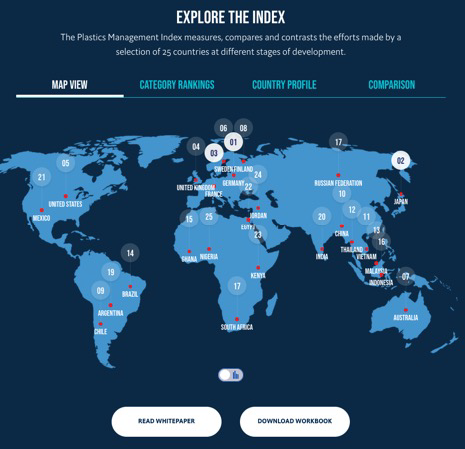
An innovative collaboration between Economist Impact and The Nippon Foundation is aiming to solve some of the most challenging ocean problems. Back to Blue calls for a zero-pollution ocean, leveraging The Economist's analytical expertise with the Nippon Foundation's focus on ocean conservation initiatives. The two organizations share a common understanding of “the need to improve evidence-based approaches and solutions to the pressing issues faced by the ocean, restoring ocean health, and promoting sustainability. The initiative will focus initially on aspects of the vexing challenge of pollution.” Two reports and a Plastic Management Index are available Back to Blue has produced two reports: Peak Plastics - Bending the Consumption Curve, evaluating the effectiveness of policy mechanisms to reduce plastic use, and A Global Ocean Free from the Harmful Impacts of Pollution: Roadmap for Action. In addition, Back to Blue has created a Plastic Management Index that measures, compares, and contrasts the efforts made by a selection of 25 countries at different stages of development. The Plastic Index looks at three categories for each country:
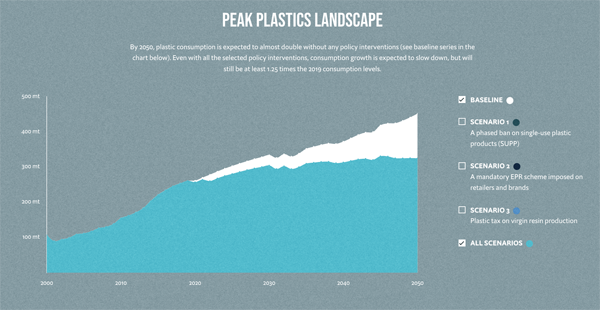
The Peak Plastics report says that “only bold and sweeping reforms will bend the plastic consumption curve. Achieving a reduction in plastic pollution will require all stakeholders - from the petrochemical companies to the consumers - to control the crisis. A piecemeal approach won’t work.”
Image credit: Back to Blue The Executive Summary of the Peak Plastic report describes modeling the impact of three regulatory measures:
The model “tests whether any of these, alone or together, can achieve peak plastic consumption before 2050. The analysis is focused on the 19 countries of the G20.” If all three policies are implemented, they will slow plastic consumption growth “but will not be enough to bring about a peak in plastic consumption by 2050, illustrating the scale of the challenge that lies ahead.” The report says bold reforms are needed and that “an integrated approach combining all three makes a dent—growth of 1.25 times the 2019 figure, compared with the baseline forecast of 1.73 times. Plastic consumption in G20 countries could nearly double by mid-century The report also references the global plastic treaty in a section that was written before the end of the last round of negotiations on December 1, 2024. It says “If the negotiators fail to agree on any policy interventions, we project that plastic consumption in the studied G20 countries will nearly double by mid-century.”
|