Two new studies point to the social cost of plastic pollution and potential solutions
In 2020, the Pew Charitable Trusts and Systemiq published “Breaking the Plastic Wave,” a credible roadmap for addressing the problem of plastic pollution using existing solutions. Now, a 2025 update provides a deeper understanding of the environmental, economic, health, and social impacts of plastic.
Without action, by 2040, the amount of plastic polluting the environment will nearly double, Pew says; plastic-related greenhouse gas emissions will undermine global efforts to stem planetary warming; and plastic production and waste will threaten the health of growing numbers of people around the world.”
A second study by Duke University’s Institute for Energy, Environment & Sustainability explores the social cost of plastic in the U.S. which the authors say is as much as $1.1 trillion annually.

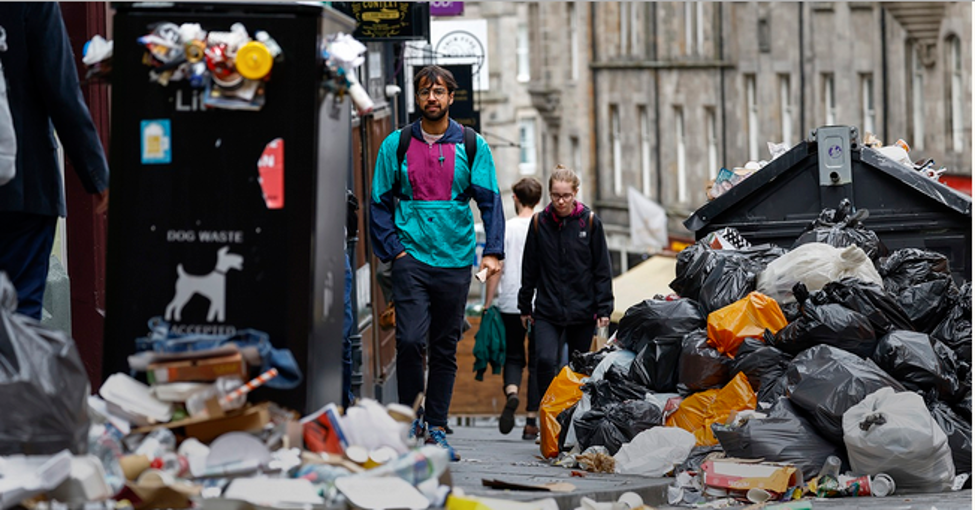
People walk past overflowing bins and piles of plastic rubbish bags in Edinburgh, Scotland, during a waste workers strike. Without action, by 2040, the amount of plastic produced each year will grow at least twice as fast as waste management capacity. Image Credit: Pew/Jeff J Mitchell/Getty Images
Breaking the Plastic Wave 2025 – people at risk
The new Pew report determined that “the global plastic system puts people worldwide at risk, with the most vulnerable bearing the brunt of the impacts. According to Tom Dillon, Senior VP, Environment and Cross-Cutting Initiatives, “The global community can remake the plastic system and solve the plastic pollution problem in a generation, but decision makers will need to prioritize people and the planet.” But how will they do it? Pew provides these high-level actions:
- Leveraging existing solutions, innovative technologies, and collaborations among business, workers, and government
- Delivering transformative shifts in the ways products are manufactured, chemicals are developed, and people receive, use, and dispose of their products.
These actions, Dillon says, bring the promise – of “healthier people, a cleaner environment and a more sustainable global economy.” Pew provided these key findings:
- Plastic pollution will more than double over 15 years. As of 2025, 130 Mt of plastic pollutes the environment each year. Without ambitious global action, that figure will rise to 280 Mt by 2040.
- Growth in plastic production will outpace waste management capacity. Absent urgent international efforts, annual primary plastic production will rise 52% from 450 Mt in 2025 to 680 Mt in 2040, growing twice as fast as waste management, and annual costs to collect and dispose of plastic would increase by 30% to $140 billion.
- Plastic can harm human health at every stage of its life cycle. Barring robust global action, health impacts from plastic production, waste, and pollution will increase by 75% over the next 15 years, primarily because of new polymer production and open burning, with the most vulnerable communities bearing the brunt. This does not include the health impacts of plastic use or microplastics, but those effects are likely to be significant.
- Greenhouse gas emissions will surge. Unless the plastic system is transformed, by 2040, annual greenhouse gas (GHG) emissions from the global plastic system will increase by 58% to 4.2 gigatons of carbon dioxide equivalents (GtCO2e) –equivalent to the emissions from one billion gasoline-powered cars.
- Ambitious global action can dramatically reduce pollution. Existing solutions could reduce annual plastic pollution by 83% by 2040. This will require unprecedented global collaboration and commitment; however, doing so would reduce annual GHG emissions from plastic by 38%, annual health impacts by 54%, and $19 billion in yearly government spending on plastic collection and disposal by 2040.
- Packaging pollution can be virtually eliminated. Plastic packaging, the largest source of plastic waste, can be nearly eradicated by 2040, decreasing 97% from 66 Mt under Business as Usual scenarios to less than 1.7 Mt by 2040. Reuse accounts for two-thirds of the total decrease, requiring a shift of nearly $570 billion in annual private sector spending away from single-use and towards reuse.
- Solving microplastic pollution will require innovative solutions. Microplastics make up 13% of global plastic pollution in 2025, with the largest sources being tyre wear and paint (10 Mt each), agriculture (3 Mt) and recycling (2 Mt). Microplastic pollution will grow from 17 to 26 Mt annually by 2040. In high-income economies it will make up 79% of overall plastic pollution by 2040. The annual flow of microplastics entering the environment could be cut by 41% by 2040 by reducing production and use, improving product design, and scaling solutions for the capture and treatment of microplastics.
- System Transformation offers opportunities for workers and communities. Reimagining the plastic system would support 8.6 million additional jobs and create new business opportunities. Effective policies to tackle plastic pollution can create jobs, help alleviate poverty and safeguard the well-being of the world’s most vulnerable people. Waste pickers could make up nearly two-thirds of the plastic workforce by 2040. These workers are not paid fairly or properly recognized for their contributions and are often exposed to hazardous conditions. Applying waste pickers’ knowledge and expertise could facilitate a successful and socially responsible transition.
- Delay is costly. Waiting just five years to initiate System Transformation would result in 1,100 Mt more primary plastic being produced, 540 Mt more plastic entering the environment and 5.3 GtCO2e more GHG emissions between 2025 and 2040, increasing costs for plastic collection and disposal by an estimated 23% annually ($27 billion).
Opportunities for policymakers, researchers and businesses
Th Pew report outlines four strategic pillars for government, the research community and business can take with details for each pillar included in the report:
- Establish measures to reduce plastic production and use.
- Rethink chemical, plastic product and system design.
- Expand participatory waste management systems.
- Unlock transparency of the plastic supply chain and its impacts.
Pew and ICF undertook the research for this new report in collaboration with the Ellen MacArthur Foundation, Imperial College London, Systemiq, and the University of Oxford, guided by a 21-member expert panel and an advisory committee.
Plastics Hidden Price Tag
The Duke report complements the Pew study by looking at the social costs associated with the plastic lifestyle in the U.S. Duke scholars found that “while plastic is cheap for the average consumer, its impacts cost Americans $436 billion to $1.1 trillion per year—and that’s likely an underestimate.
According to Nancy Lauer, staff scientist at Duke’s Environmental Law and Policy Clinic. “Fossil fuel subsidies keep plastics relatively inexpensive in the United States. But as our report reveals, the true economic, environmental, and health costs to society are far greater.”
- Human health impacts from plastic use account for an estimated $410 billion to $930 billion per year. Toxic chemicals found in plastics—such as phthalates, PFAS, BPA and flame retardants—have been connected to cancer, cardiovascular disease, reproductive disorders and neurological conditions. These and other health-related impacts are associated with healthcare expenses, lost worker productivity and premature death.
- Greenhouse gas emissions ($6.4 billion–$15.9 billion): Emissions—primarily generated through fossil fuel extraction and plastic production—contribute to climate-related harms, including extreme weather, rising healthcare costs and reduced agricultural productivity.
- Human health impacts from fossil fuel extraction ($2.9 billion–$31.9 billion): Fracking and other operations to extract oil and gas emit air pollutants linked to asthma, cancer and premature death.
- Landfilling ($2.9 billion): Most plastic waste in the United States—86% as of 2019—is disposed of in landfills, with the direct costs usually falling to local governments.
- Plastic litter cleanup ($9.8 billion–$13.3 billion): State and local governments, businesses, educational institutions, and volunteer organizations remove plastic litter from roadsides, waterways, and public spaces.
- Costs to marine industries ($3 billion): Plastic debris deters tourism ($2 billion) damages marine shipping ($909 million), and degrades fisheries and aquaculture ($88 million).
- Impacts on marine ecosystem services ($1.4 billion–$112 billion): Marine plastic pollution reduces fisheries’ productivity, diminishes biodiversity, and limits recreational opportunities, among other losses in ecosystem services.
The report says that understanding the long-term health implications of constant plastic ingestion and the complex interactions between the thousands of chemicals found in plastics are just beginning to be understood. “As those are better understood, the cost estimates identified in our report are likely to rise, and investments in research and development are urgently needed to reduce or eliminate harmful plastic exposures and mitigate the negative health consequences of plastic."
Share: https://www.openoceans.org/blog/Blog47/Two-new-studies-point-to-the-social-cost-of-plastic-pollution-and-potential-solutions
Share Category "Trash and Plastics":
https://www.openoceans.org/blog/BlogCategory6/Trash-and-Plastics