Solving ocean crises by unifying and empowering global communities!sm
With the help of donors like you, OpenOceans Global is developing solutions to save our ocean.
With the help of donors like you, OpenOceans Global is developing solutions to save our ocean.
Title search: ✖
|
Show All (49)
General (8) OpenOceans News (2) OPP Initiative (1) Plastic Treaty (9) Press Releases (2) Solutions (8) Trash and Plastics (24) White Papers (1)
New Report Provides Global Criteria to Address Problematic, Unnecessary, and Avoidable Plastic Products
Corporate Plastic Pollution Scorecard provides an in-depth review of the plastic packaging practices
|
Pew report addresses US waste management challenges posed by plastic
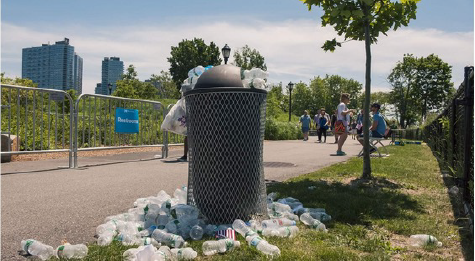
Plastic bottles litter the ground in Franklin D. Roosevelt Four Freedoms State Park in New York City. Image credit: Pew/Education Images Universal Images Group via Getty Images Although U.S. contributions of plastic to the ocean are small relative to other global inputs, the amount of plastic and plastic waste created in the U.S. continues to grow. The U.S. is one of the world’s largest plastic producers and waste generators, and plastic consumption is projected to more than double between 2019 and 2060. In 2019 alone, the country spent $2.3 billion landfilling plastic waste. A new February 2026 report from Pew Charitable Trusts and ICF International Inc. models policy options to reduce plastic packaging waste in municipal solid waste (MSW) and microplastics from textiles and tires. It compares business-as-usual (BAU) trends with alternative policy scenarios through 2040. Key findings
Reuse policies would reduce packaging waste and pollution Although reuse is not yet widely employed, several states—Maine, Maryland, Minnesota, Oregon, and Washington—have recently passed extended producer responsibility legislation that requires, for example, restaurants to use reusable service ware, or for certain products to be sold in refillable or reusable packaging. Shifting just 13% of single-use packaging to reusable systems could reduce packaging waste by 11%, pollution by 12%, and save taxpayers over $1 billion annually.
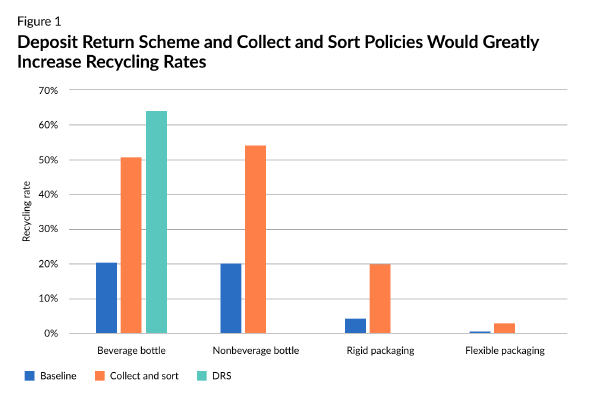
Note: Values have been rounded. Source: The Pew Charitable Trusts, "Modeling Policy Options for Reducing Plastic Packaging Waste and Microplastic in the United States," 2026. © 2026 the Pew Charitable Trusts A national deposit return system for beverage containers could reduce bottle pollution by 41%, raise recycling rates from 6.3% to 15% by 2040, and cut landfill and incineration costs by nearly $700 million per year. Quadrupling collection and increasing sorting efficiency would result in a slightly greater overall recycling rate than the DRS scenario and capture more types of plastic packaging. Improving collection and sorting would require a $21 billion investment from 2025 to 2040. Microplastics: tires and textiles Microplastics are defined as particles less than 5 millimeters. Tires and textiles generated about 1 million tons of microplastic pollution in 2025, projected to rise to 1.2 million tons by 2040 under BAU. Nearly all tire particles and most textile microfibers are released into the environment. Textiles are projected to generate 6,700 tons of synthetic microfibers in 2025, with this number growing 22% by 2040 to 8,100 tons in the BAU scenario. In 2040, roughly 5,700 tons of microfibers (71% of those generated) are lost to the environment, with 38% entering the aquatic environment. Tires are projected to generate 1 million tons of tire wear particles in 2025, with this number growing by 15% to 1.2 million tons in 2040. 99% of tire wear particles generated are released directly into the environment, with 7% reaching the aquatic environment. Proposed solutions include reducing microfiber shedding, adding washing machine filters, reducing vehicle miles traveled, improving tire design, and restricting biosolids application on farmland. Even combined, these measures would cut microplastic pollution by only about 15%. Overall, the report underscores that addressing U.S. plastic pollution will require coordinated upstream and downstream policies—especially reuse and product redesign—rather than relying on recycling alone. |