Solving ocean crises by unifying and empowering global communities!sm
With the help of donors like you, OpenOceans Global is developing solutions to save our ocean.
With the help of donors like you, OpenOceans Global is developing solutions to save our ocean.
Title search: ✖
|
Show All (49)
General (8) OpenOceans News (2) OPP Initiative (1) Plastic Treaty (9) Press Releases (2) Solutions (8) Trash and Plastics (24) White Papers (1)
New Report Provides Global Criteria to Address Problematic, Unnecessary, and Avoidable Plastic Products
Corporate Plastic Pollution Scorecard provides an in-depth review of the plastic packaging practices
|
World Economic Forum likens ocean economy to 2008 financial crash
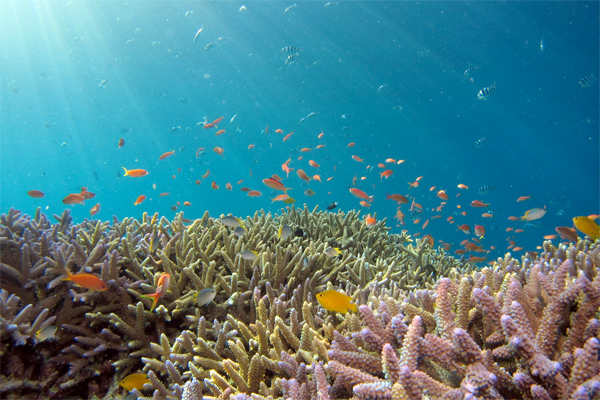
Image credit: World Economic Forum/Unsplash/Hiroko Yoshii In an April 22, 2026, article, the World Economic Forum compares the current state of the ocean economy with the time before the 2008 financial crash. These three findings dominate the article.
Ocean-dependent businesses don’t account for the ecological risk The article says that “Before 2008, subprime mortgages became an investable asset class because investors ignored the risks for a quick return. A similar dynamic today gives us ‘subprime blue investments.’” These are ocean-dependent businesses whose valuations depend on healthy ocean ecosystems, but account for none of the ecological risk they’re accumulating.“ The article uses two examples: a premium restaurant whose menu depends on fisheries with depleted stocks and a hotel chain whose scuba excursions require healthy coral, yet whose operations reduce it. Marine plastic pollution also could have negative impacts on businesses — the growing concern about plastic in fish impacting seafood consumption and a scuba diving-based tourist operation avoided because of ocean plastic pollution in previously clear waters. Undermining nature is economic suicide WEF says: “In 2023, $7.3 trillion flowed into nature-negative activities, while just $220 billion supported nature-based solutions. Effectively, for every dollar spent protecting nature, $30 is spent undermining it. Because more than half of global GDP depends on nature and its services, this is economic suicide.” Fisheries and aquaculture, tourism, coastal and oceanic shipping, carbon sequestration, and biotechnology have an estimated asset value of over $24 million, according to the World Wildlife Fund. No Federal Reserve Bank for the biosphere WEF cites some statistics from the 2024 Living Planet Report.
WEF says “these are not abstract environmental metrics. They are unrecorded credit events on our collective balance sheet – and unlike 2008, there is no Federal Reserve for the biosphere.” While not in the WEF article, adding plastic to the mix worsens the situation. According to the Pew Charitable Trusts, plastic pollution reaching the ocean will nearly triple from 11 million metric tons in 2016 to 29 million metric tons in 2040 under a business-as-usual scenario. How do those statistics tip the balance sheet? Reporting mechanisms have the data but ignore them Healthy marine ecosystems are often the basis for a company’s revenues. The risks to those ecosystems are not acknowledged as risks to revenues. Our ocean accounting systems “treat the ocean as though it is not a depreciating asset. It is. We are simply not writing it down.” The WEF article says three actions can reverse these shortfalls in accounting for nature and the ocean in our economic models:
“None of this is technically complicated. It is politically and institutionally inconvenient – precisely what was said about mortgage reform in 2006.” The article concludes with this: “We have built a global economy as though the natural systems beneath it are permanent – infinitely resilient, endlessly forgiving, always available for one more draw. They are not. The economy is a subset of the environment, not the other way around. The short on marine health is already in. The question is whether the reform comes before the margin calls, or after.” Read the full article here: “The ocean is now a subprime asset. Only a sustainable blue economy will calm the waters.” |