Solving ocean crises by unifying and empowering global communities!sm
With the help of donors like you, OpenOceans Global is developing solutions to save our ocean.
With the help of donors like you, OpenOceans Global is developing solutions to save our ocean.
Title search: ✖
|
Show All (49)
General (8) OpenOceans News (2) OPP Initiative (1) Plastic Treaty (9) Press Releases (2) Solutions (8) Trash and Plastics (24) White Papers (1)
New Report Provides Global Criteria to Address Problematic, Unnecessary, and Avoidable Plastic Products
Corporate Plastic Pollution Scorecard provides an in-depth review of the plastic packaging practices
|
New Report Examines the "Greenness" of BioPlasticsA March 10, 2026, paper in Environmental Research Communications explores the variety, degradation, and environmental effects of bioplastic. The report says “it is not accurate as a blanket statement, to say that, in general, bioplastics are ‘greener’ or more ‘environmentally friendly’ than conventional plastics. However, there are some bioplastics that do degrade within a reasonable time in some or many environments, and may in themselves be of low toxicity.” The paper determined that ‘“there are a great variety of different products claimed to be bioplastics, and they differ greatly in many characteristics.” The paper reviews “the large diversity of bioplastic products derived from biological materials and compares their various physio-chemical characteristics with conventional (petroleum-derived) plastics.” Key elements of the report include:
Is it BioBased or Biodegradable? Or Both?
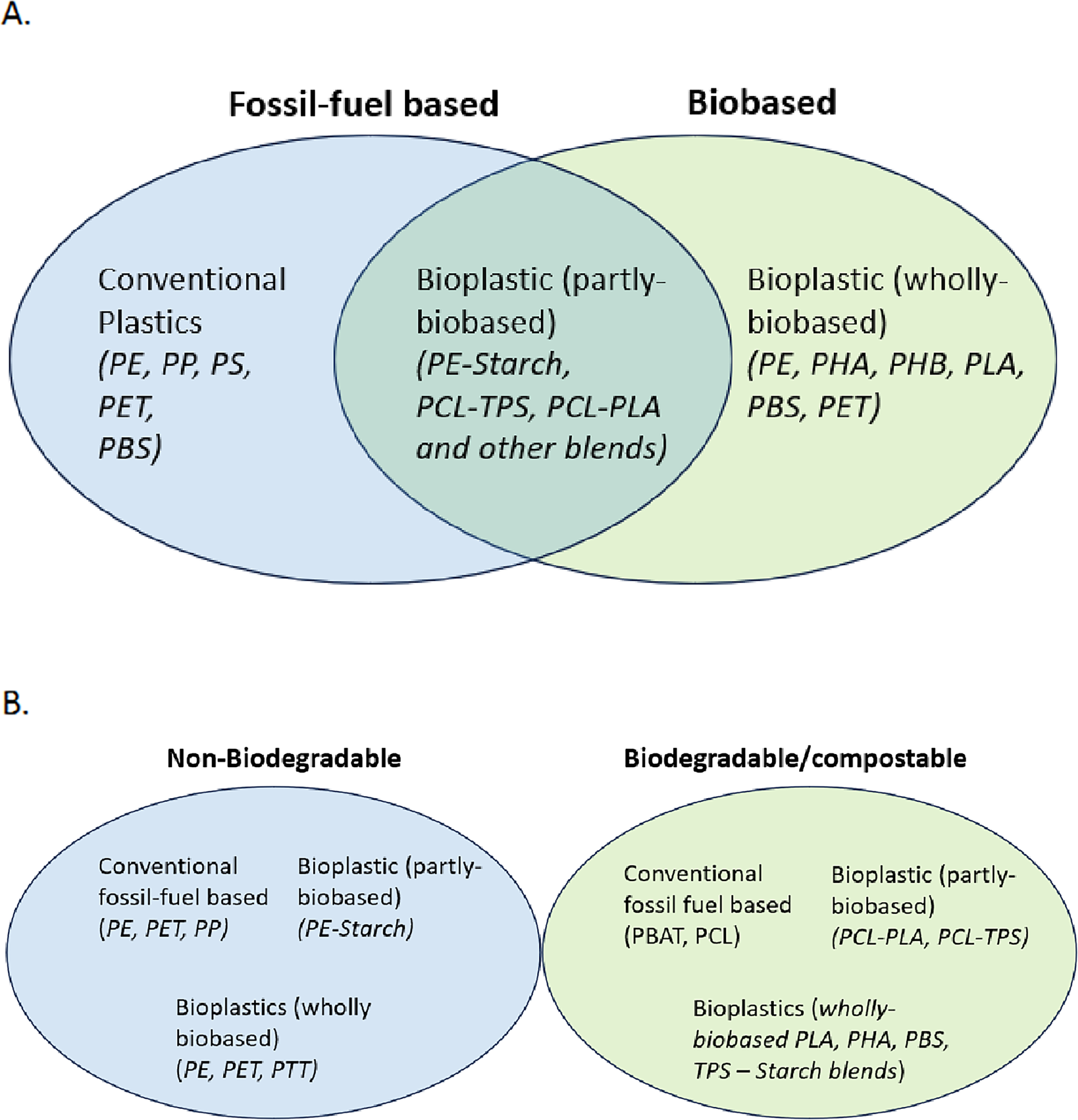
Figure 1. (A) Overlap between biobased and fossil-fuel based plastics; (B) Biodegradability of biobased and fossil-fuel based plastics (PE = polyethylene, PP = polypropylene, PET = polyethylene terephthalate, PBS = poly(butylene succinate), PHA = poly-hydroxy-alkanoate, PCL = polycaprolactone, PBAT = polybutylene adipate terephthalate, PHB = polyhydroxybutyrate (a specific PHA), PLA = polylactic acid, PTT = polytrimethylene terephthalate, PA = polyamide, PS = polystyrene, TPS = thermoplastic starch). Image credit: Environmental Research Communications As evidenced by the above graphic, bioplastics come in many forms with varying degrees of biogradabiility and compostability. Even the definitions of bioplastics are different from reputable sources.
These alternate definitions and others essentially dance around whether the material is based on biological materials rather than fossil fuels and whether the definition should include fossil fuel-based plastics that are biodegradable. “Both fossil-fuel and biobased plastics may be biodegradable or non-biodegradable … whether the raw material was fossil fuel or biobased (figure 1 above).” Toxicity and Biologic Effects of Degradation Products The report says “Toxicity from plastics is not due primarily to the plastic polymer itself, but rather to the numerous additives contained in the plastic (both conventional and bioplastic), including chemicals of concern such as bisphenols and phthalates.” Some studies have shown that “the degradation products of bioplastics are similar in toxicity to conventional plastics, although there are studies in which bioplastic degradation products had either higher or lower toxicity.” Some studies only looked at large pieces of plastic while others looked at microplastics or leachates. The report took an in-depth look at studies on toxicity on bacteria as well as terrestrial and aquatic organisms. Conclusions The report concluded that it “is difficult to draw definite conclusions about bioplastics (BPs) in general in terms of their potential for degradation and environmental effects.” It is clear that while some bioplastics …degrade substantially within environmentally relevant time periods in a variety of specific natural environments (e.g., soil, water) and treatment systems (e.g., composting), many others do not, or do so only under limited conditions, such as industrial composting, or after prolonged exposures.” Regarding toxicity, the report concludes that “Plastic products may include a wide variety (possibly hundreds) of chemicals in addition to the main polymer(s), and at least some of the observed toxic effects are believed to be associated with them, rather than the polymers themselves. In fact, degradation of the polymer may release these toxic compounds more rapidly or in greater concentrations than occurs with conventional plastics.” Finally, the report says “it is not accurate as a blanket statement, to say that, in general, bioplastics are ‘greener’ or more ‘environmentally friendly’ than conventional plastics. However, there are some bioplastics that do degrade within a reasonable time in some or many environments, and may in themselves be of low toxicity.” |