Solving ocean crises by unifying and empowering global communities!sm

Title search:


Report: How AI is used for global ocean conservation and management

A new report from OCTO reveals trends in how artificial intelligence (AI) is being used in the global ocean conservation and management field. OCTO connects ocean professionals and surveyed thousands of its user communities.

 OCTO Report.png

Image credit: OCTO

The survey asked respondents these key questions:

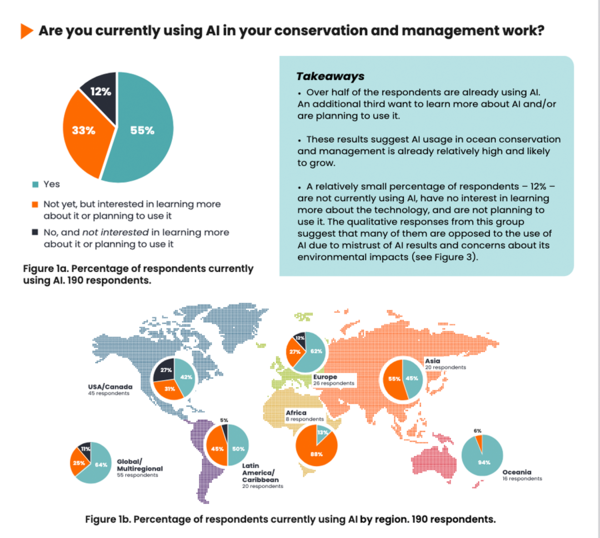
Are you currently using AI in your conservation and management work?

  • Over half of the respondents are already using AI.
  • One third want to learn more about AI and/or are planning to use it.
  • These results suggest AI usage in ocean conservation and management is already relatively high and likely to grow.
  • 12% are not currently using AI, have no interest in learning more about the technology, and are not planning to use it.
  • Many of those opposed mistrust AI results and are concerned about its environmental impacts.

How are you currently using AI?

  • The most common current uses are assistance with writing, editing, literature review, and research – where AI is being used primarily to increase productivity.
  • Respondents want to move toward more analytical applications of AI to inform science and management decisions, modeling, forecasting, and other data analysis.

We use AI tools for grant applications. The funds available to our commercial business are mainly Government schemes, which have a great deal of policy and regulatory sections that require detailed information. LLM tools are able to produce this quickly and accurately, which lets us focus our time instead on the project delivery sections.

- Private sector professional, Europe, 11-20 years in the field

What obstacles are you encountering in using AI?

  • The main obstacle was the lack of knowledge about how to use AI
  • Trust issues and lack of resources are also important.
  • Values-based and ethical concerns about AI are widespread, but less than 10% of respondents cited these concerns as actual obstacles.

There are several ways I hope to use AI in my research but have not yet been able to implement. These include automated species identification from field images and videos, which is limited by lack of region-specific training datasets; predictive modeling of bycatch hotspots, which is constrained by insufficient integrated data and computing capacity; and AI-based community reporting apps for fishers, for which we are limited by technical expertise and funding.

- Researcher, Africa, 6-10 years in field

What concerns do you have about the use of AI in ocean conservation and management?

  • There was a wide array of concerns about using AI, including mistrust of results; data privacy and security; and the environmental impacts of AI data centers.
  • Other concerns such as the loss of human skills and input; lack of governance and guidelines; and deepening inequality and power imbalances did not appear to be significant enough to be widespread obstacles to using AI.

AI is a growing contributor to global carbon footprints. The single biggest threat to coral reefs is global warming. I feel like every request to ChatGPT should be prefaced by "This will cost you one coral; do you want to proceed?"

- NGO professional, Asia, over 20 years in field

What information do you most need to know about AI?

  • Build AI Literacy. Respondents expressed a need for a range of technical and practical information about AI, including what it is, how it works, and how to begin using it.
  • Develop practical and ethical guidelines. Respondents stressed the need for clear frameworks and guidance to support responsible AI adoption.

How do we know if we can trust AI-generated information or data? And how do we keep ourselves safe and secure while using AI in our organization?

- NGO professional, Latin America/Caribbean, over 20 years in the field

OCTO received responses from 190 ocean professionals. The respondents represented the following major ocean institution types:

  • (35%) NGOs or Indigenous or local organizations
  • (27%) academic or research institutions
  • (24%) government or intergovernmental organizations
  • (14%) consultants or other private sector roles

Experience varied:

  • (27%) 5 years or less
  • (20%) 6–10 years
  • (25%) 11–20 years
  • (29%) 20 years or more

OCTO connects ocean professionals to the knowledge and networks they need. Through its programs and communities, it empowers conservationists and resource managers to apply best practices worldwide.

Share: https://www.openoceans.org/blog/Blog65/Report-How-AI-is-used-for-global-ocean-conservation-and-management

Share Category "General":
https://www.openoceans.org/blog/BlogCategory4/General

Please support our efforts, donate today!